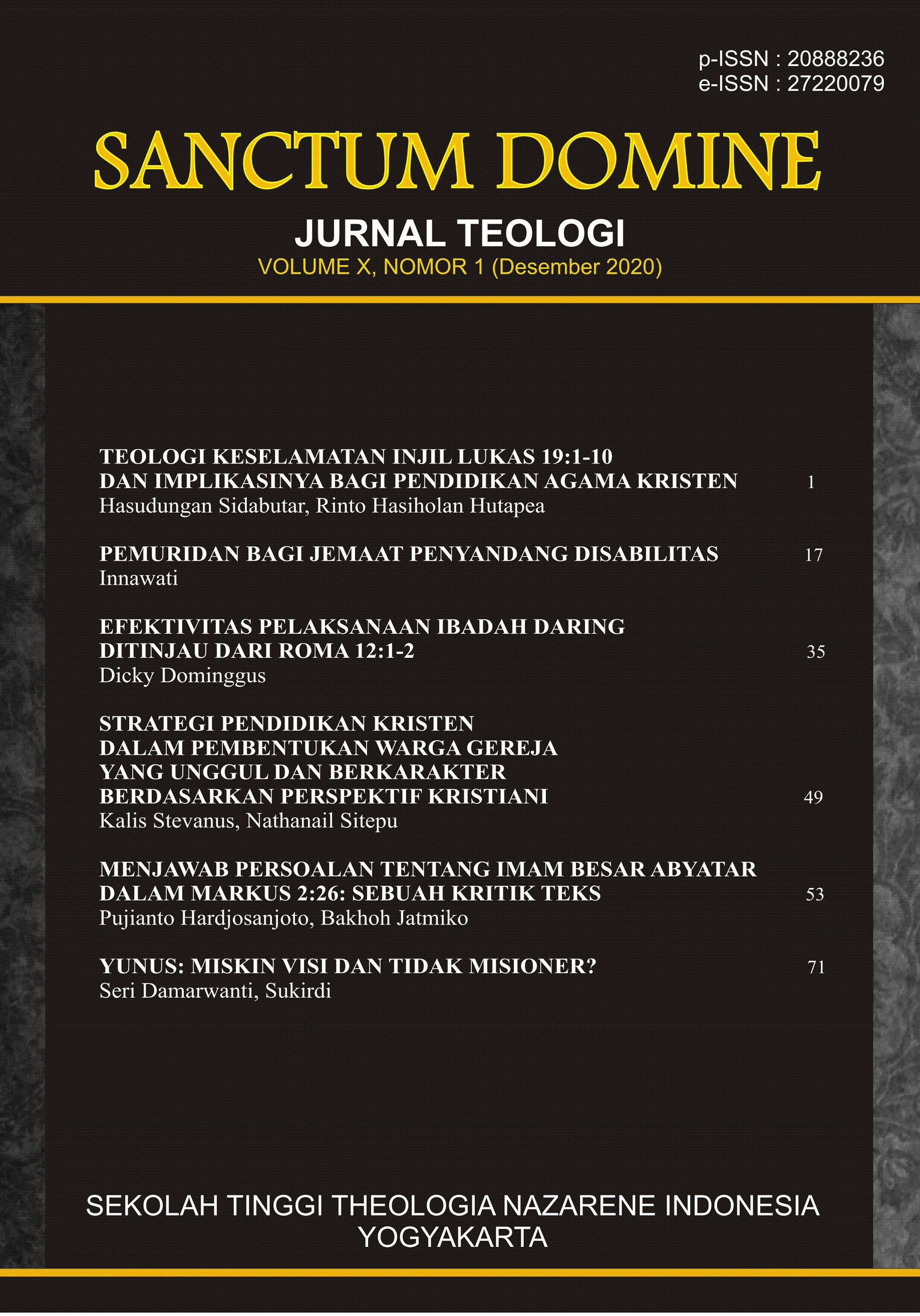
Teologi Keselamatan Injil Lukas 19:1-10 dan Relevansinya Bagi Pendidikan Agama Kristen
DOI:
https://doi.org/10.46495/sdjt.v10i1.80Keywords:
Theology of Salvation, Luke 19:1-10, Christian EducationAbstract
This study explores the concept of salvation. The study aims to answer the problem of differences in the concept of safety that students have in schools. The research method used in this research is qualitative research with a literature approach. The results of the research are as follows: First, the salvation of the Old Testament to the New Testament is the salvation of God Himself. Second, man is not saved by his own efforts but rather the Work of God, who is active in the work of salvation. Third, the Gospel of Luke contains a universal theology of salvation. Fourth, salvation does not look at boundaries, but salvation from God through Jesus Christ breaks through the boundaries made by humans. Fifth, human judgment is not the determinant of salvation but only God Himself should place it. Sixth, the concept of salvation in the Gospel of Luke 19: 1-10 can be considered in Christian Religious Education learning materials in schools.
References
Boland, B. J. Tafsiran Lukas. Jakarta: BPK Gunung Mulia, 2013.
Carlson, G. Raymond. Keselamatan. Malang: Gandum Mas, 1983.
Duyverman, M. E. Pembimbing Ke Dalam Perjanjian Baru. Jakarta: BPK Gunung Mulia, 2002.
Fohrer, Georg. Theological Dictionary of The New Testament. Michigan: Grand rapids, 1971.
Haldenguis, J. L. Ensiklopedia Alkitab Masa Kini Jilid II. Jakarta: Yayasan Komunikasi Bina Kasih, 2008.
Handayani, Dessy. “Tinjauan Teologis Konsep Iman Dan Perbuatan Bagi Keselamatan.” EPIGRAPHE: Jurnal Teologi dan Pelayanan Kristiani 1, no. 2 (2018): 91.
Jura, Demsy. “Kajian Soteriologi Dalam Teologi Universalisme, Calvinisme Dan Armenianisme Serta Kaitannya Dengan Pembelajaran Pendidikan Agama Kristen.” SHANAN: Jurnal Pendidikan Agama Kristen 1 No. 2 (n.d.).
Leks, Stefan. Tafsir Injil Lukas. Yogyakarta: Kanisius, 2003.
Manurung, Frans Setiadi. “Teologi Keramahan Allah: Sebuah Pembacaan Kristologi Lukas.” Gema Teologika 3, no. 2 (2018): 185.
Nuhamara, Daniel. Pembimbing Pendidikan Agama Kristen. Bandung: Jurnal Info Media, 2009.
Pangaribuan, Robert. “Menyikapi Perbedaan Pandangan Christology from Above and Christology from Below.” SOTIRIA: Jurnal Teologi dan Pelayanan Kristiani 2, no. 1 (2019): 17–20.
Purwantara, Iswara Rintis. “Kritik Hermeneutis Terhadap Interpretasi Soteriologis Perumpamaan Tentang Anak Yang Hilang Dalam Lukas 15:11-32.” Prudentia: Jurnal Teologi dan Pendidikan Kristiani 1, no. 1 (2018).
Richaeson, Alan. Salvation Dalam The Interpreter Dictionary of The Bible. New York: Abingdon Press, 1962.
Setiawan, David Eko. “Refleksi Pastoral Terhadap Konsep Keselamatan Dalam Universalisme Ditinjau Dari Soteriologi Kristen.” FIDEI: Jurnal Teologi Sistematika dan Praktika 1, no. 2 (2018): 250–269.
Tannenhill, Robert C. Abingdon New Testament Commentary: Luke. New York. Abingdon Press, 1996.
Tuckett, Cristopher M. Luke. England: Shelfield Academic Press, 1996.
Willcock, J. The Preacher’s Complete Homiletic Commentary: Commentary on the Gospel According to LUKE. Grand Rapids: Baker Books, 1996.
Zaluchu, Sonny Eli. Biblical Theology: Pembahasan Metodologi Dan Pendekatan Biblika Dalam Membangun Teologi PL Dan PB Yang Alkitabiah. Semarang: Golden Gate Publishing, 2017.
Downloads
Published
How to Cite
Issue
Section
Citation Check
License
Copyright (c) 2020 SANCTUM DOMINE: JURNAL TEOLOGI

This work is licensed under a Creative Commons Attribution-NonCommercial-ShareAlike 4.0 International License.
Copyright:
SANCTUM DOMINE: Jurnal Teologi will validate, produce, disseminate, and act as steward in the long-term curation of every article published. In order to achieve this, the author typically requires a transfer or “assignment” of the copyright in the article. As is the case for open access publishing, the author (or copyright owner of the article, if different) signs an author publishing agreement. The agreement incorporates the necessary transfer of copyright.
After assigning copyright, the author will still retain the right to:
- Be credited as the author of the article.
- Own and exercise any trademark or patent rights held by author and addressed in the article.
- Make printed copies of the article to use for a lecture or class that the author leading on a non-commercial basis.
- Share the article with friends, colleagues and influential people the author would like to read the work.
- Present the article at a meeting or conference and distribute printed copies of the article on a non-commercial basis.
License:
This work is licensed under a Creative Commons Attribution-NonCommercial-ShareAlike 4.0 International License.
You are free to:
- Share — copy and redistribute the material in any medium or format
- Adapt — remix, transform, and build upon the material
- The licensor cannot revoke these freedoms as long as you follow the license terms.
Under the following terms:
- Attribution — You must give appropriate credit , provide a link to the license, and indicate if changes were made . You may do so in any reasonable manner, but not in any way that suggests the licensor endorses you or your use.
- NonCommercial — You may not use the material for commercial purposes .
- ShareAlike — If you remix, transform, or build upon the material, you must distribute your contributions under the same license as the original.
- No additional restrictions — You may not apply legal terms or technological measures that legally restrict others from doing anything the license permits.
Notices:
You do not have to comply with the license for elements of the material in the public domain or where your use is permitted by an applicable exception or limitation .
No warranties are given. The license may not give you all of the permissions necessary for your intended use. For example, other rights such as publicity, privacy, or moral rights may limit how you use the material.

8.png)